Sustainability Champion, Mike Londo
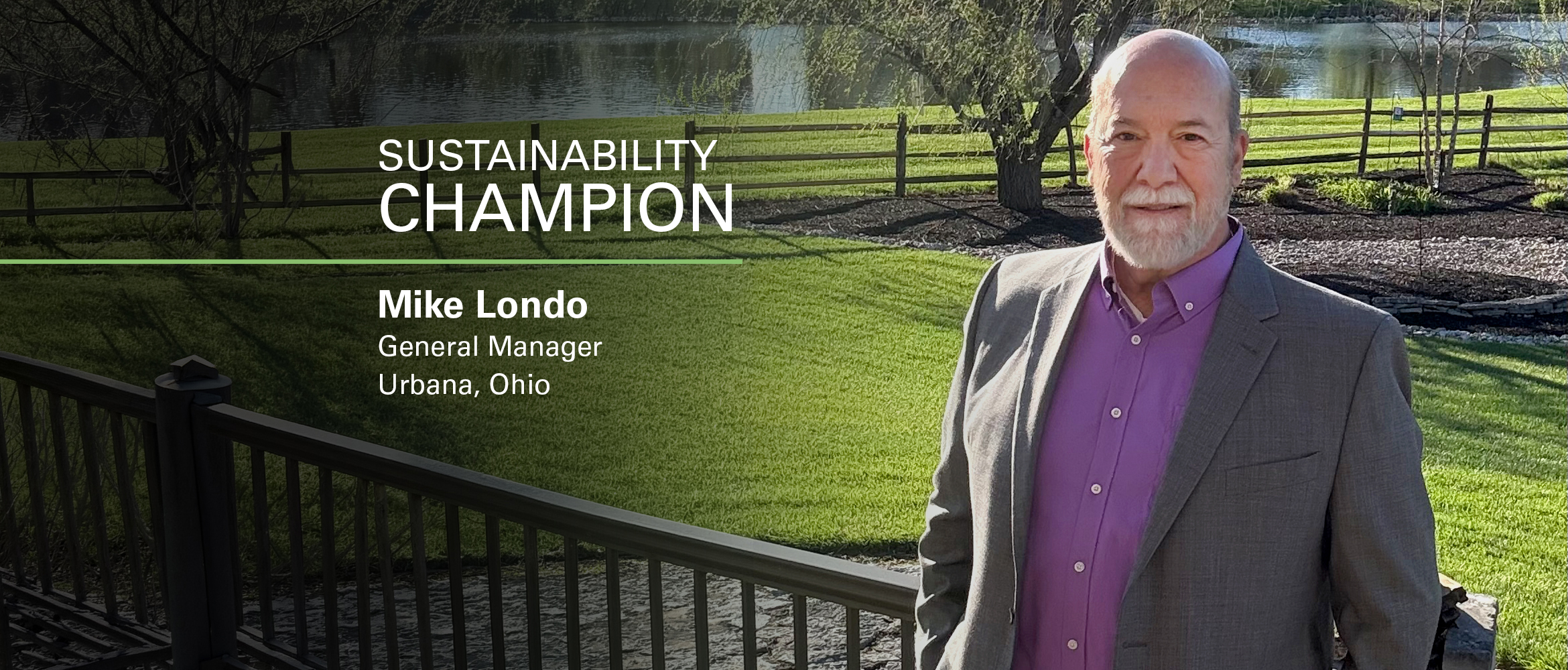
Mike Londo joined Weidmann Urbana in June 2022 as Technical Manager, bringing more than 38 years of experience in the technical and development areas of papermaking, coating, and converting as both a supplier and manufacturer. He became General Manager in July 2024. Mike holds a Bachelor of Science degree in chemistry from St. Norbert College and graduated from the Market Management Program and earned a Technology Entrepreneurial and Commercialization (TEC) certificate from the NC State School of Management. He holds six US patents in three different markets: carbonless paper, packaging, and clay processing and beneficiating.
Mike is originally from Green Bay, Wisconsin, and a huge Packer fan. He enjoys traveling to see his family and explore the world. He has two sons and a granddaughter whom he delights in spoiling. He’s an avid motorcycle enthusiast and enjoys fishing, hiking, water skiing, and camping.
Four years ago, Weidmann Urbana embarked on environmentally friendly stewardship. What does that include, what triggered this shift, and what did the site look like before that commitment?
While we always prioritized responsible environmental management, in 2022 we renewed our focus, triggered in part by a commitment to reduce material waste and landfill disposal – reflecting our broader organizational values.
In the early days, Urbana had a recycling area that relied heavily on water usage and discharge to a nearby creek, managed in accordance with EPA permits. We were still in the early phases of developing our production capabilities and wanted to send our effluent stream to Urbana’s municipal water treatment facility. They helped us set specifications to work toward. We are currently working to advance our environmental stewardship practices as the site evolves and our production capacity increases.
Can you explain the water treatment evolution and how you went from using VOC (volatile organic compounds) scrubbers to achieving non-detectable contaminant levels? What did that journey require from the team?
The Urbana Weidmann facility sits above a significant aquifer, a resource that has historically supported paper manufacturing operations in the region and attracted multiple paper mills to Ohio.
Before Weidmann acquired the property, industrial activities in the area had contaminated the aquifer. As part of the purchase agreement and in accordance with regulatory requirements, Weidmann installed and operated VOC scrubbers to support remediation efforts and protect and improve water quality.
We operated these scrubbers for 13 years, conducting quarterly testing in accordance with EPA permit requirements. A comprehensive review of data from the most recent two-year period indicated that contaminant levels were consistently non-detectable. Based on these findings, Weidmann formally requested that the Ohio EPA decommission the VOC scrubbing system. Following a regulatory review, our request was granted, and the VOC scrubbers were shut down. We continue to utilize aquifer water in compliance with existing permits. Our team remained fully aligned throughout the process, responsibly completing the remediation phase while maintaining compliance and environmental integrity.
The water nanofiltration and reverse osmosis systems allow you to recycle water back into production or return it to municipal treatment. How significant is this for Urbana’s water footprint?
Prior to implementing nanofiltration and reverse osmosis systems, the Urbana facility consumed approximately one million gallons of water per day. Nanofiltration improved the treated water for use; however, the resulting effluent did not meet requirements for discharge to the municipal wastewater system. As a result, the effluent continued to discharge to a local creek, with routine sampling confirming compliance within permitted limits.
We then investigated reverse osmosis to treat the concentrate stream generated by the nanofiltration process. This concentrate, previously included in the overall effluent stream, was identified as an opportunity for recovery and reuse. The reverse osmosis enabled us to purify the stream enough to reintroduce it into the production process.
These combined efforts reduced our water usage by approximately 250,000 gallons per day – a 25% decrease compared to baseline operations. We now produce paper far more efficiently in terms of water use, marking a noteworthy achievement within the paper manufacturing industry.
You’ve gone from landfilling paper material to “zero material outflow to landfill.” How was this achieved financially? What part do local recycling mills play in this achievement, and how has it been received by the community?
To further improve effluent management, we partnered with the Ohio EPA and applied for assistance through its grant program, which funds up to 50% of capital expenditures for qualified projects.
With one of the awarded grants, we implemented Derrick screens within the reject stream from the primary cleaning process. The screens recover usable fiber, which is then returned to the production system, improving overall material efficiency.
Our dissolved air flotation (DAF) system then removes additional fiber from the effluent stream, improving TSS (Total Suspended Solids) levels. However, the recovered material was only 24% solids, making it impractical for reuse by local recycling mills. Made up of roughly 75% water, transportation costs outweighed the material’s value.
To address this challenge, a second Ohio EPA-supported project was initiated to install a Vincent Press to increase solids content to 50%. At this level, the material would have sufficient value for external reuse. While the recovered fiber cannot be reused internally due to the extraction treatment chemicals, increasing the solids content made it saleable to local recycling mills.
These initiatives successfully transformed a cost-intensive waste stream – previously destined for landfill – into a modest revenue-generating byproduct.
Projects like these increase visibility within our community and the broader region. Our neighbors are notably pleased with the reduction of truck traffic to and from our facility.
What’s next for Urbana’s sustainability roadmap? Are there remaining challenges or new opportunities to explore?
We are researching a process to remove Novolac resin from our DPP (Diamond Print Paper). Unlike local recyclers, we don’t have on-site de-inking capabilities. Establishing this capability would allow us to recover our specialized pulp internally, without the need for off-site recycling.
This would reduce transportation activity and decrease our reliance on externally purchased pulp, further lowering costs and environmental impacts.